Introducing Brego Fraud Check
Brego Fraud Check helps lenders, brokers and dealers spot ghost-car risk and related seller evidence issues before payout.
Fraud Check is now available on Brego Platform
Brego Fraud Check is now available on Platform, giving lenders, brokers and dealers a faster way to review risk before approving a finance payout.
Ghost cars are the headline problem Fraud Check is built to answer. In a ghost-car scenario, the vehicle identity may look real, the valuation may look sensible and the customer journey may appear normal, but the proposing seller may not actually have the vehicle, title or physical possession. Fraud Check brings the surrounding evidence into one workflow so teams can decide whether to proceed, manually review or hold payout.
It also helps with related problems such as duplicate listings, seller mismatch, weak seller evidence, unusual vehicle identity signals and cases where the proposed sale does not line up with the visible market evidence.
Why ghost-car risk needs a different control
Vehicle finance fraud often sits between traditional checks. A valuation answers what a vehicle may be worth. A vehicle history check can surface markers such as outstanding finance, write-off, stolen, taxi or salvage records. Customer checks help validate the applicant.
But car fraud asks another question before funds move: does the seller appear genuinely connected to this vehicle, at this price, right now?
That question is difficult to answer from a single lookup. A fraudulent proposal may use a real VRM, a real VIN or a real advert, but the seller in the finance proposal may not have stocked, advertised or physically controlled the vehicle. By the time the issue becomes clear, the payout may already have gone.
Fraud Check helps teams review that evidence earlier.
How Fraud Check works
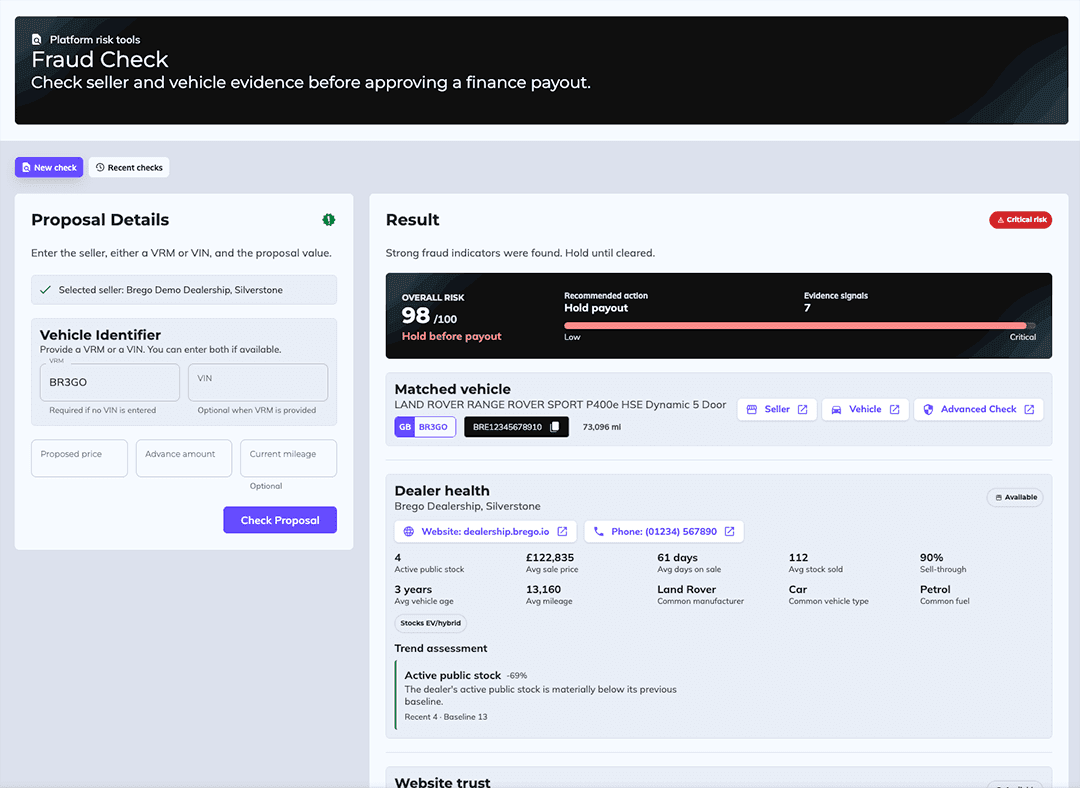
Inside Brego Platform, a user can search for a seller, then enter a VRM or VIN for the proposed vehicle. They can also add the proposed price, advance amount and current mileage. Where useful, a company record can be selected to support Companies House checks.
Brego then reviews the proposal against multiple evidence layers and returns a structured result. The result includes an overall risk score, a risk band, a recommended action, supporting evidence signals and suggested next steps.
The recommendation is intentionally operational. Lower-risk cases can proceed through normal controls. Medium or high-risk cases can move into manual review. Critical cases can be held before payout until title, stock and physical possession evidence has been checked.
Evidence Fraud Check brings together
Fraud Check combines several signals that are hard to review consistently when they sit in separate systems.
It can help surface whether Brego has found listing evidence connecting the seller to the proposed vehicle. It can show whether the same vehicle appears active with another seller, whether there is a listing history pointing away from the proposing seller, or whether there is no recent seller stock evidence.
Those signals are central to ghost-car review because they help answer whether the seller appears to have had a real market relationship with the vehicle.
Fraud Check can also review vehicle identity evidence, including VRM and VIN context, and can bring in previous search evidence from Advanced Check workflows. Where permissions allow, this can include wider vehicle history context such as taxi or salvage checks.
Seller and dealer context is also part of the result. Fraud Check can show active public stock, average sale price, average days on sale, sell-through, common manufacturer, common fuel type and other dealer profile signals. That helps teams understand whether the proposed vehicle looks consistent with the seller's visible market profile.
For business identity, Fraud Check can review Companies House context such as company status, years trading, overdue accounts or confirmation statements, insolvency markers, officers, persons with significant control and recent filings. It can also inspect seller website trust markers such as domain age, recent updates and expiry signals.
The image layer adds another useful source of evidence. Fraud Check can compare current and historical listing image context, review seller stock image groups and use AI Image Analysis where appropriate. Digital evidence does not prove physical possession on its own, but it can help highlight inconsistencies that deserve manual review.
Benefits for lenders
For lenders, Fraud Check is a pre-payout risk tool. It helps teams move from isolated checks to an evidence-led view of the proposed asset and seller.
That can support:
- Faster triage of finance proposals.
- More consistent manual review decisions.
- Stronger loan-to-value and seller-evidence checks.
- Earlier detection of ghost-car, seller mismatch and duplicate listing signals.
- Better audit trails for underwriting, fraud and compliance teams.
- Clearer next steps when a case needs stock book, title, invoice, delivery or vehicle photo evidence.
The goal is not to block good business. It is to focus attention where the evidence looks unusual, before the payout leaves the business.
Benefits for dealers
Fraud Check also matters for dealers. Legitimate dealers want clean proposals to move quickly. When the seller has credible stock evidence, consistent listing history and a normal market profile, that evidence can help reduce unnecessary friction.
For dealer groups, Fraud Check can also support stronger internal controls. It gives teams a clearer view of how vehicles, sellers, listings and business records line up before a deal progresses. That can help separate genuine stock from proposals that need more evidence.
In a market where ghost-car fraud and related seller impersonation risks damage trust across the trade, credible dealers benefit from better evidence.
Better controls without slowing every case
Fraud Check is designed to help teams apply the right level of friction. Not every proposal needs an investigation. Some should proceed through normal controls. Others should be reviewed by an underwriter or fraud team. A smaller number should be held until the seller proves title and physical possession.
That distinction is where the feature is useful. It gives the user a risk band, a recommended action and the reasons behind it, rather than leaving teams to reconcile valuation, listings, seller data, company records and vehicle checks manually.
The recent checks view also means teams can return to previous results, review who ran a check and keep an organization-level history of activity.
A stronger pre-payout workflow
Fraud Check brings Brego's vehicle intelligence, listing evidence, seller analytics and risk signals together in one Platform workflow.
For lenders, it can strengthen payout controls and reduce reliance on fragmented manual checks. For brokers, it can help identify cases that need more evidence before submission or payout. For dealers, it can support faster funding where the evidence is clean and more focused questions where it is not.
Vehicle finance decisions are strongest when value, identity, seller evidence and market context are reviewed together. Fraud Check has been built to make ghost-car risk and related seller evidence issues easier to review inside Brego Platform.
Brego Fraud Check is available to all existing Brego customers. New customers can book a demo now to get started.
Ready to test it?
Get a 1 week trial of our Platform for free so you can test our claims and accuracy for yourself.